Baylor Graduate Programs: MBA, PhD, Master's Degrees & What Grad Students Need to Know

Researching baylor graduate programs means you're already serious — this isn't a casual inquiry. Choosing a graduate school means committing two to five years of your life, a significant amount of money, and serious career momentum to one institution. Here's a clear-eyed look at what Baylor actually offers, which programs stand out, how funding works, and what life looks like on the ground in Waco.
Baylor's Graduate School: The Big Picture
Baylor University's graduate division spans 11 schools and colleges with more than 50 graduate and professional programs. Total graduate enrollment sits around 3,500 students — a size that matters. Big enough to have serious research infrastructure and competitive funding; small enough that cohorts are tight-knit and you actually know your faculty.
The graduate school is SACSCOC accredited. Applications go through apply.baylor.edu. The main graduate school office is at 1311 S 5th St — about a 5-minute walk from much of campus.
The Major Baylor Graduate Programs
Hankamer School of Business (MBA, MPA, MS Programs)
Hankamer is the flagship. The MBA comes in four formats: Full-Time (traditional two-year cohort), Professional MBA (evenings and weekends), Executive MBA, and Online MBA. AACSB accredited. Consistently ranked by Poets&Quants and US News for programs in the South.
The program catalog goes well beyond the MBA:
- MS in Accounting (MPA — Master of Professional Accounting)
- MS in Finance
- MS in Data Science
- MS in Supply Chain Management
All classes meet in the Foster Campus for Business and Innovation, a 200,000-square-foot facility that opened in 2019 and sits roughly 0.7 miles from 19Eleven Apartments on S 8th Street. If you're in the Professional MBA — evening and weekend classes on top of a full-time job — living close enough to walk to campus without fighting for parking matters.
Louise Herrington School of Nursing (MSN, DNP, PhD)
One of Baylor's most consistently ranked schools. Graduate tracks include:
- MSN with concentrations in Family Nurse Practitioner, Nursing Education, and Neonatal
- DNP (Doctor of Nursing Practice)
- PhD in Nursing
The clinical rotation schedule at Providence Healthcare Network and Baylor Scott & White hospitals adds complexity to daily logistics. Nursing grad students need housing that's reliable, quiet, and close to both campus and the medical district — a noisy undergrad complex near 4th Street isn't the right fit.
School of Engineering & Computer Science (MS and PhD)
ECS is Baylor's fastest-growing program by enrollment. Graduate degrees include:
- MS and PhD in Computer Science
- MS and PhD in Electrical & Computer Engineering
- MS in Civil Engineering
- MS in Biomedical Engineering
Research-heavy, lab-intensive programs. The ECS building is about 0.7 miles from 19Eleven — walkable in about 14 minutes. When you're running experiments until 9pm, that proximity changes the math on how your evenings go.
Baylor Law School (JD and LLM)
The Sheila & Walter Umphrey Law Center sits at 1114 S University Parks Dr — about 0.5 miles from 19Eleven. Baylor Law offers a JD (three-year, full-time only) and an LLM for international students. The school ranks in the US News top 100 and is known for its intensive practice court training program, which sets Baylor law grads apart in trial work.
Three years of intensive coursework means stable, quiet housing isn't a preference — it's a requirement. Students who live walking distance from the law school consistently have less friction in their day-to-day than those commuting from across town.
College of Arts & Sciences (MA and PhD)
The largest undergraduate college at Baylor also has the broadest graduate portfolio, with MA and PhD programs in:
- Biology, Chemistry, and Biochemistry
- Psychology
- History, English, and Philosophy
- Religion and American Studies
These programs often come with graduate assistantships — stipend plus tuition waiver — in exchange for teaching or research. If you're aiming for an academic career, a funded PhD in Arts & Sciences at Baylor is one of the more financially viable paths in the Texas university system.
Other Baylor Graduate Programs Worth Knowing
Diana R. Garland School of Social Work offers an MSW program — one of only 12 Christian social work programs in the United States. If that framing matters to you, it's one of the few places you'll find it.
George W. Truett Theological Seminary is a graduate-only professional seminary on Baylor's main campus offering M.Div., ThM, DMin, and PhD in Religion. Truett is a serious theological institution with a separate academic culture from the rest of Baylor graduate programs.
Application Timelines for Baylor Graduate Programs
Most Baylor graduate programs operate on a fall-priority cycle. Deadlines generally land between August and November of the year before enrollment. Spring admission is available for some programs, with February–March deadlines.
The deadlines vary significantly by school — don't assume your timeline. The Hankamer MBA deadline differs from a PhD in Biology deadline by months. Check each program's admissions page directly at graduate.baylor.edu/degrees-programs.
Standard application components for most programs:
- Transcripts from all undergraduate institutions
- Standardized test scores — GMAT for MBA; GRE for most other programs; some programs have waived standardized tests entirely
- Statement of purpose
- Two to three letters of recommendation
- Writing sample (for humanities and social science PhDs)
Funding: What You Should Actually Expect
Funding varies dramatically by program, and the gap matters enormously for your financial planning:
Funded programs — PhD programs in Arts & Sciences and Engineering typically offer graduate assistantships: a stipend (usually $15,000–$25,000/year depending on the field and your funding level) plus a full tuition waiver in exchange for teaching a section or supporting a professor's research. If you're admitted to a funded PhD, your direct cost is essentially your living expenses.
Self-funded programs — Professional master's degrees like the MBA, MPA, MS in Finance, and the law school JD are not typically covered by assistantships. These are treated as professional degrees and financed through federal graduate loans, institutional scholarships, and employer tuition benefits.
Nursing sits between these poles — some fellowships and clinical scholarships exist, but most nursing graduate students take on loans.
Check graduate.baylor.edu/funding for the current landscape before committing. For funded PhD students, Waco's cost of living becomes a meaningful part of the equation — more on that below.
Where Baylor Graduate Students Actually Live
Baylor has no dedicated graduate housing. Every grad student who doesn't commute from elsewhere has to find their own apartment in Waco.
Most graduate students end up within 1.5 miles of campus. The concentration is highest along the S 8th Street corridor and adjacent south Waco neighborhoods — areas that are walkable, relatively quiet, and close to the buildings where most graduate work happens.
19Eleven Apartments at 1911 S 8th Street sits 0.5 miles from campus — within walking distance of every major Baylor graduate school building. The walkable distance to each building from 19Eleven:
- Umphrey Law Center: 0.5 miles
- ECS Engineering Building: 0.7 miles
- Foster Campus for Business (FCBI): 0.7 miles
- Graduate School main office: 0.5 miles
- McLane Student Life Center (study spaces, health services): 0.5 miles
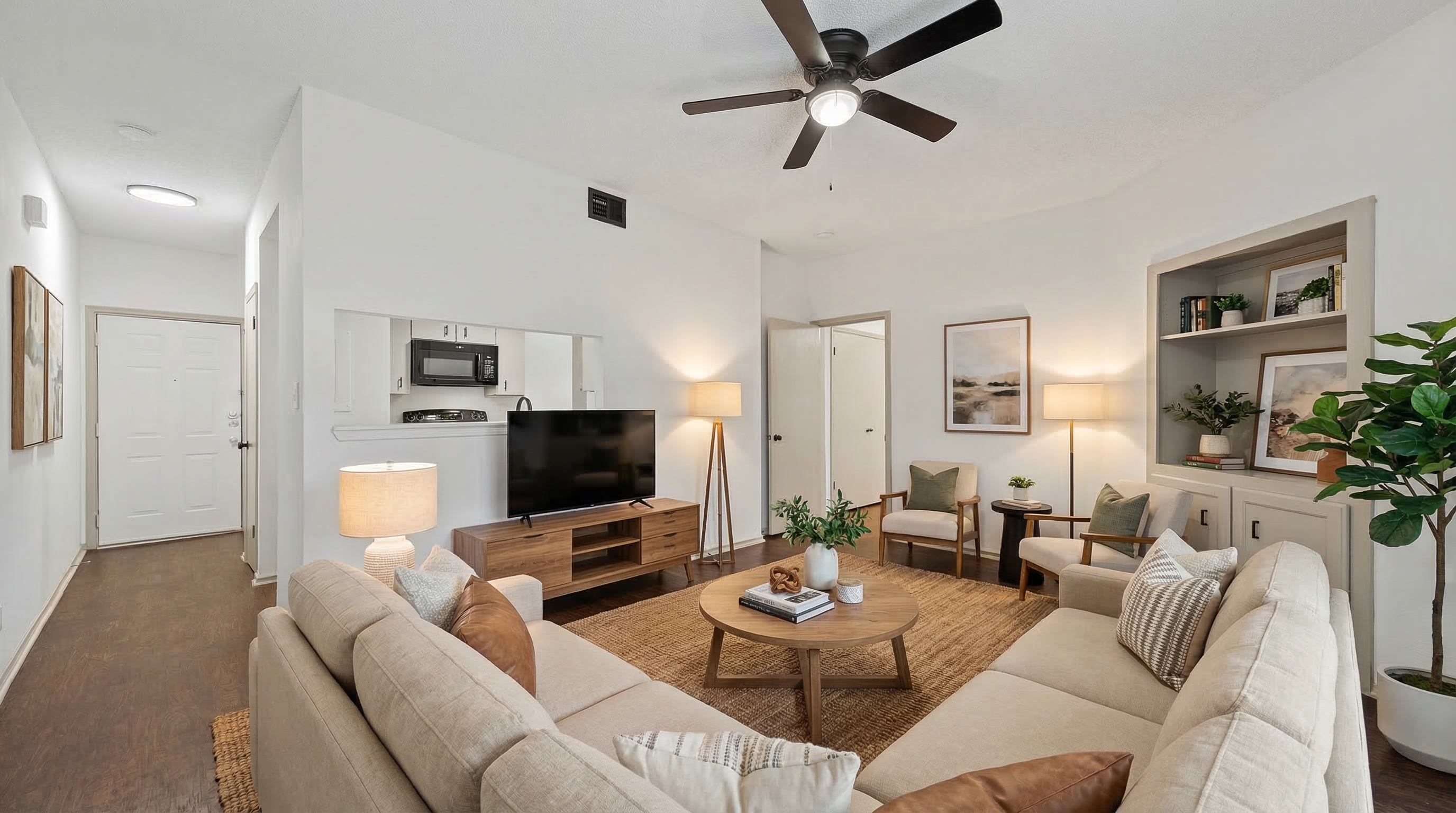
For graduate students specifically, the apartment setup matters more than the amenity list. The things that actually affect your productivity: study rooms available 24/7 (critical for dissertation writing and bar exam prep), a loft-style layout with distinct bedroom separation (which gives you a real home office), and a gated community where you're comfortable working late and walking home.
Lease structure is also worth thinking about. 19Eleven offers 12-month leases aligned with Baylor's academic year. Graduate students on research contracts or clinical rotations often need housing year-round — a lease that expires in May doesn't serve you well if you're in Waco for summer research.
On cost: 1-bedroom apartments at 19Eleven run $1,035–$1,250/month. For a funded PhD student on a $20,000 stipend, that's roughly 60–75% of monthly income toward rent — tight, but workable in Waco in a way it wouldn't be in Austin. A 2-bedroom split with another grad student at $1,295–$1,530/month drops each person's share to $650–$765, which is much more livable on a stipend. The $97/month flat fee covers common-area utilities, which keeps your monthly costs predictable.
Baylor vs. Other Texas Graduate Programs
If you're comparing baylor graduate programs to UT Austin, Texas A&M, or TCU, a few things actually differentiate Baylor:
Cohort size: Smaller cohorts than UT or A&M mean more direct faculty access — meaningful if you're doing research-intensive work where advisor relationships define your experience.
Waco cost of living: Significantly lower than Austin. A $20,000/year stipend is barely rent in Austin; in Waco it covers rent and leaves money for the rest of your life.
Faith integration: Baylor explicitly integrates Christian mission into its academic culture. The Truett Seminary and Garland Social Work school are the clearest examples, but the framing extends across programs. If that matters to you, it's a real differentiator. If it doesn't, it's mostly invisible in day-to-day academic life.
Location: Waco is on I-35 between Dallas and Austin — 90 minutes from each. Not urban, but not isolated either.
For funded PhD students especially, the Waco cost advantage is real in a way that compounds over a five-year program. What you save on rent relative to Austin goes toward conference travel, research materials, and the financial slack that lets you do better academic work.
Plan Your Next Step
Whether you're targeting the Hankamer MBA, a PhD in Computer Science, or Baylor Law, knowing the landscape of baylor graduate programs helps you make a cleaner decision about where to spend the next two to five years.
If you've been admitted and you're figuring out housing, schedule a tour of 19Eleven to see what the closest walkable apartments to campus actually look like. Or browse floor plans to find the layout that fits your situation — 1-bedroom for solo work, 2-bedroom split with another grad student for better economics.
For a deeper look at the student experience, read our guide on Baylor University majors to understand Baylor's academic structure across all levels, and our housing-focused guide on off-campus options for Baylor graduate students for a practical breakdown of the Waco rental market. The cost of living guide for Baylor students runs the full monthly budget numbers — worth reading if you're comparing stipend offers across schools.
Graduate school starts with the program. It plays out in where you live.